GuidesAfghan calendars
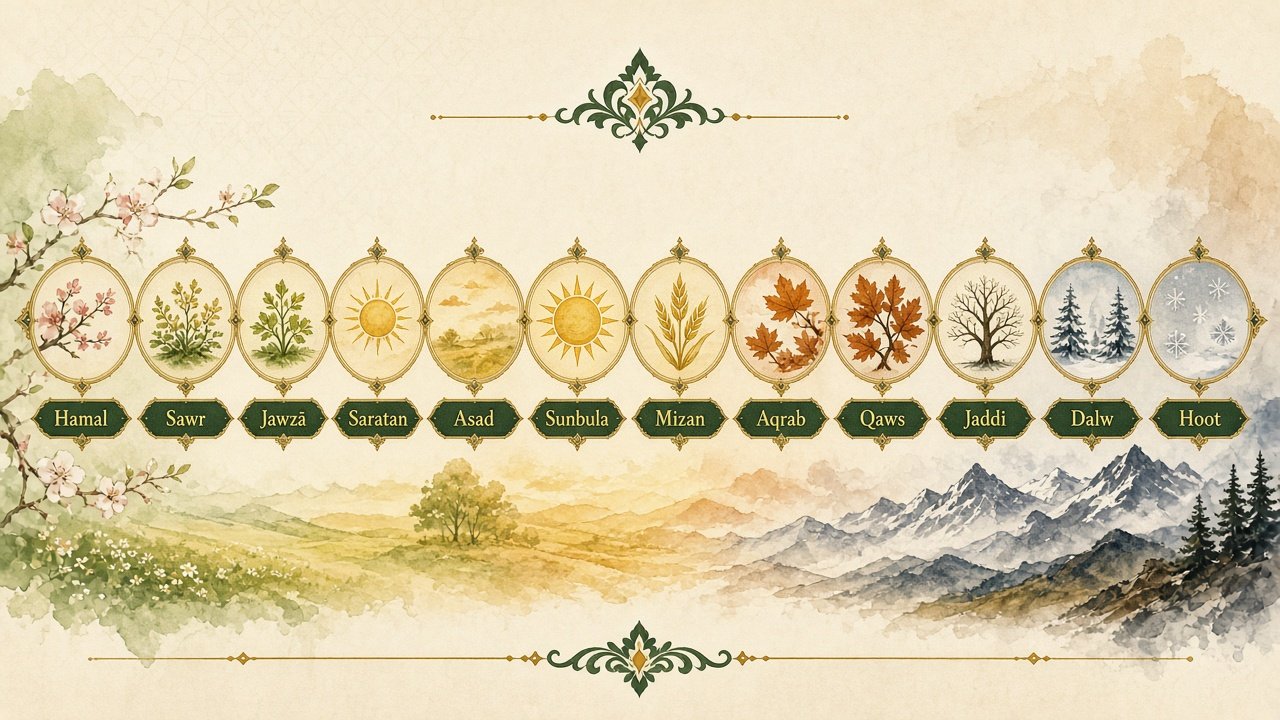
Afghan Month Names in Dari and Pashto (with Miladi Ranges)
Learn the twelve Afghan Shamsi months with Dari and Pashto names, day counts, and approximate Miladi date ranges used in Afghanistan.
Why month names matter more than numbers
Afghans often speak in month names, not only numbers. A relative might say “the twentieth of Sawr” rather than “month 2, day 20.” Forms and software, meanwhile, may expect a number from 1 to 12. Knowing both the spoken name and the ordinal prevents booking errors and awkward clarifications.
This guide lists the twelve Afghan Shamsi months with common Dari and Pashto names, typical lengths, and the Miladi span they roughly cover. Ranges shift slightly by year because Nowruz moves between about 20 and 21 March, so treat Miladi ranges as orientation—not a substitute for conversion.
How the twelve months are structured
Months 1–6 have 31 days. Months 7–11 have 30 days. Month 12 has 29 days in a common year and 30 in a leap year. That pattern is one of the easiest ways to spot an invalid date someone typed by habit from the Miladi calendar.
The year begins with Hamal around Nowruz. Counting forward from Hamal is the standard civil order used in Afghanistan. If you see Persian-influenced spellings online, compare them carefully to Afghan Dari and Pashto forms used locally.
Months 1–6 (31 days each)
Hamal (حمل / وری) opens the year and overlaps late March and April. Sawr (ثور / غويی) covers much of April–May. Jawza (جوزا / غبرګولی) maps to May–June. Saratan (سرطان / چنګاښ) covers June–July. Asad (اسد / زمری) spans July–August. Sunbula (سنبله / وږی) covers August–September.
These six months feel long because each has 31 days. Agricultural and school planning often references them. When converting, remember that a day number up to 31 is normal here—unlike Miladi April, which never has 31 days.
- 1 Hamal — late March to April
- 2 Sawr — April to May
- 3 Jawza — May to June
- 4 Saratan — June to July
- 5 Asad — July to August
- 6 Sunbula — August to September
Months 7–12 (30 days, then 29/30)
Mizan (میزان / تله) roughly covers September–October. Aqrab (عقرب / لړم) maps to October–November. Qaws (قوس / ليندۍ) covers November–December. Jadi (جدی / مرغومی) spans December–January. Dalwa (دلو / سلواغه) covers January–February. Hut (حوت / کب) ends the year in February–March and is the leap-sensitive month.
Because Hut can be 29 or 30 days, never invent a 30 Hut date unless you know the year is leap. The Solar Hijri guide and Shamsi year calendar on this site help you inspect a specific year instead of guessing.
- 7 Mizan — September to October (30 days)
- 8 Aqrab — October to November (30 days)
- 9 Qaws — November to December (30 days)
- 10 Jadi — December to January (30 days)
- 11 Dalwa — January to February (30 days)
- 12 Hut — February to March (29 or 30 days)
Dari and Pashto naming in practice
Dari and Pashto speakers may prefer different everyday names even when the month index is identical. Afghan Date Converter lets you prefer Dari-style or Pashto-style solar month labels in settings so the interface matches how your household speaks.
When writing for a mixed audience, include the month number in parentheses the first time you mention a name: “Sawr (2).” That habit reduces ambiguity for readers who know only one language’s month vocabulary.
Tips for learning the months quickly
Learn the first three and the last month first—Hamal, Sawr, Jawza, and Hut—because they sit near Nowruz and the year boundary where people make the most conversion mistakes. Then memorize the 31-day vs 30-day split as a rule rather than twelve separate exceptions.
Practice by converting today’s date every morning for a week. Say the Shamsi month name aloud, then check the Miladi range. Pair this article with the interactive Shamsi calendar so you see names next to a full month grid.
Using month names with the tools on this site
The Solar Hijri calendar guide page includes a full table of Dari and Pashto names with scripts and zodiac associations. The Shamsi calendar year view is better when you need to click a specific day. The converter is best when you already know day, month, and year and need the Miladi equivalent immediately.
If you are preparing teaching material or an onboarding doc for staff who handle Afghan dates, link this guide plus the converter. Clear month literacy prevents more errors than any single spreadsheet formula.
Written for Afghan Date Converter by Khalid Danishyar. For feedback, visit Contact.